
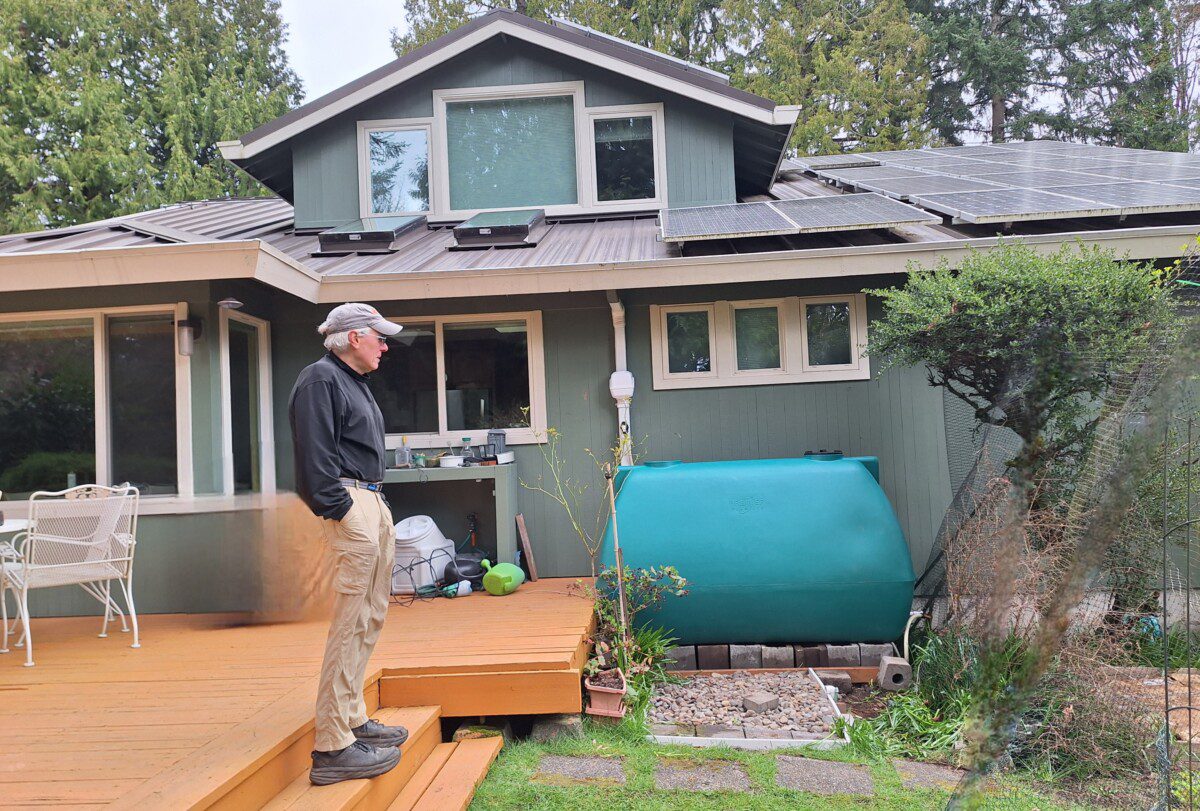
A simple rainwater harvesting calculation shows how an 825 square foot roof can collect thousands of gallons during the spring-to-fall rainy season.
The homeowner’s motivation was simple. “I just wanted to use more of the rain that’s already falling on the house,” the homeowner explained. “It seemed strange to keep using treated city water for plants when we get rain most of the year.”
Like many homeowners in the Pacific Northwest, summer watering was the real concern. The goal was to support gardens and landscaping during the dry season without relying entirely on municipal water.
Before installing the system, the homeowner wasn’t sure how much water the roof could realistically provide. “I honestly didn’t know if it would add up to much,” they said. “You see rain barrels that hold fifty gallons, and it’s hard to imagine that making a difference over a whole summer.”
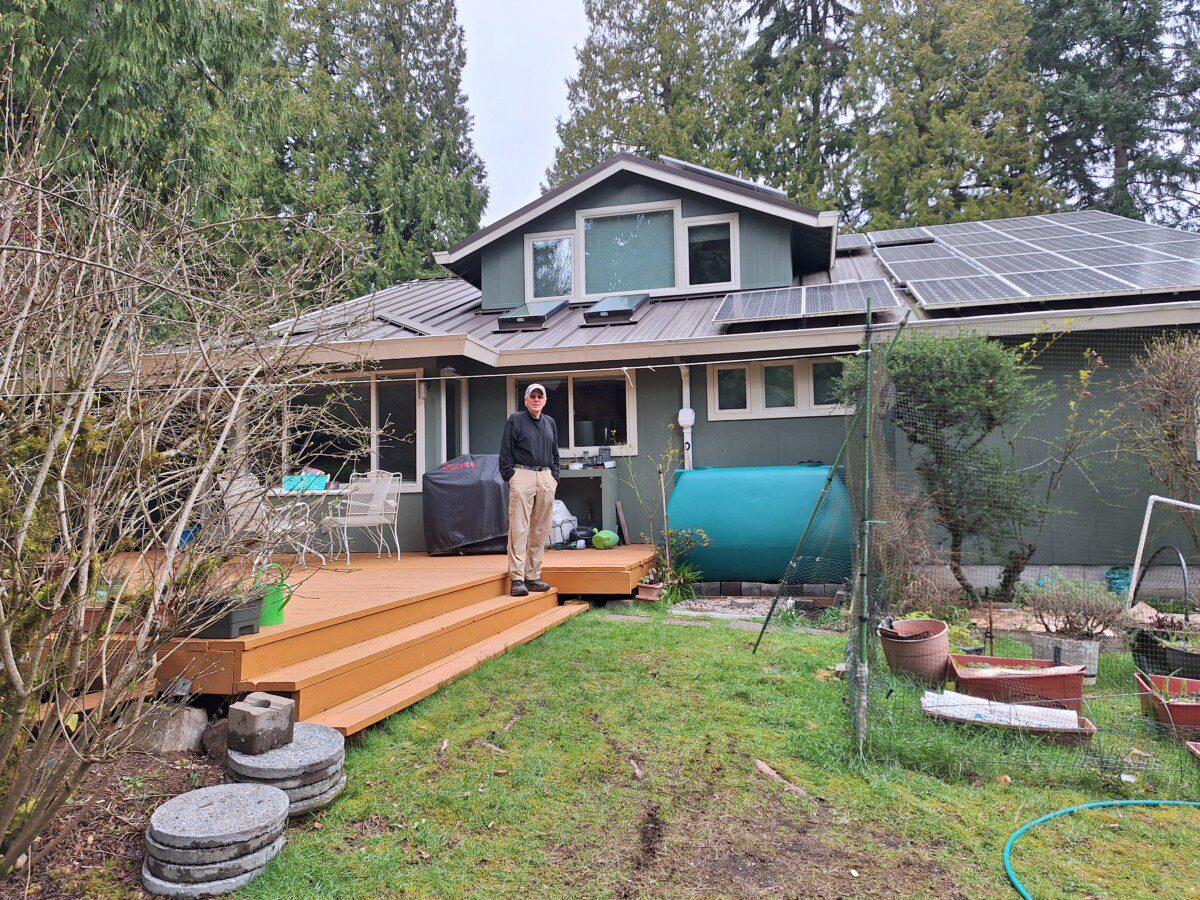
To estimate the potential, we start with a simple rainwater harvesting calculation. This home has approximately 825 square feet of roof area. Instead of using total annual rainfall, it is more useful to focus on the months when homeowners actually need water for outdoor use.
In this region, roughly 16 inches of rainfall occurs between April and October. Rainwater harvesting calculations use a standard conversion factor: 1 inch of rain on 1 square foot of roof produces 0.623 gallons of water.
Using that formula:
16 × 825 × 0.623
This equals approximately 8,224 gallons of rainfall landing on the roof during the spring through fall season.
Of course, rainwater systems never capture every drop. Small losses occur through gutter splash, first-flush diversion, and overflow behavior. After accounting for typical system performance, the usable amount becomes roughly 7,400 gallons of water between April and October.
When the homeowner saw the numbers, the scale of roof runoff became clear. “I didn’t realize the roof was producing that much water,” they said. “Once you see the math, it really makes sense.”
Rainwater harvesting systems work by redirecting roof runoff before it reaches the ground. Rain lands on the roof, flows into the gutters, and normally travels down the vertical downspouts toward the drainage system.
This installation uses a gravity-based design, allowing a portion of that water to be redirected into storage while the rest continues through the normal drainage path. A key component is a downspout diverter.
The diverter sits inside the vertical downspout and redirects a portion of the water sideways into a storage tank. The remaining water continues down the downspout so the building’s drainage system functions normally.
“It’s pretty straightforward,” the homeowner said. “The rain goes into the gutter, some goes into the tank, and the rest just keeps going down the downspout.” Gravity-based systems are reliable because they work with the natural direction water already wants to move.
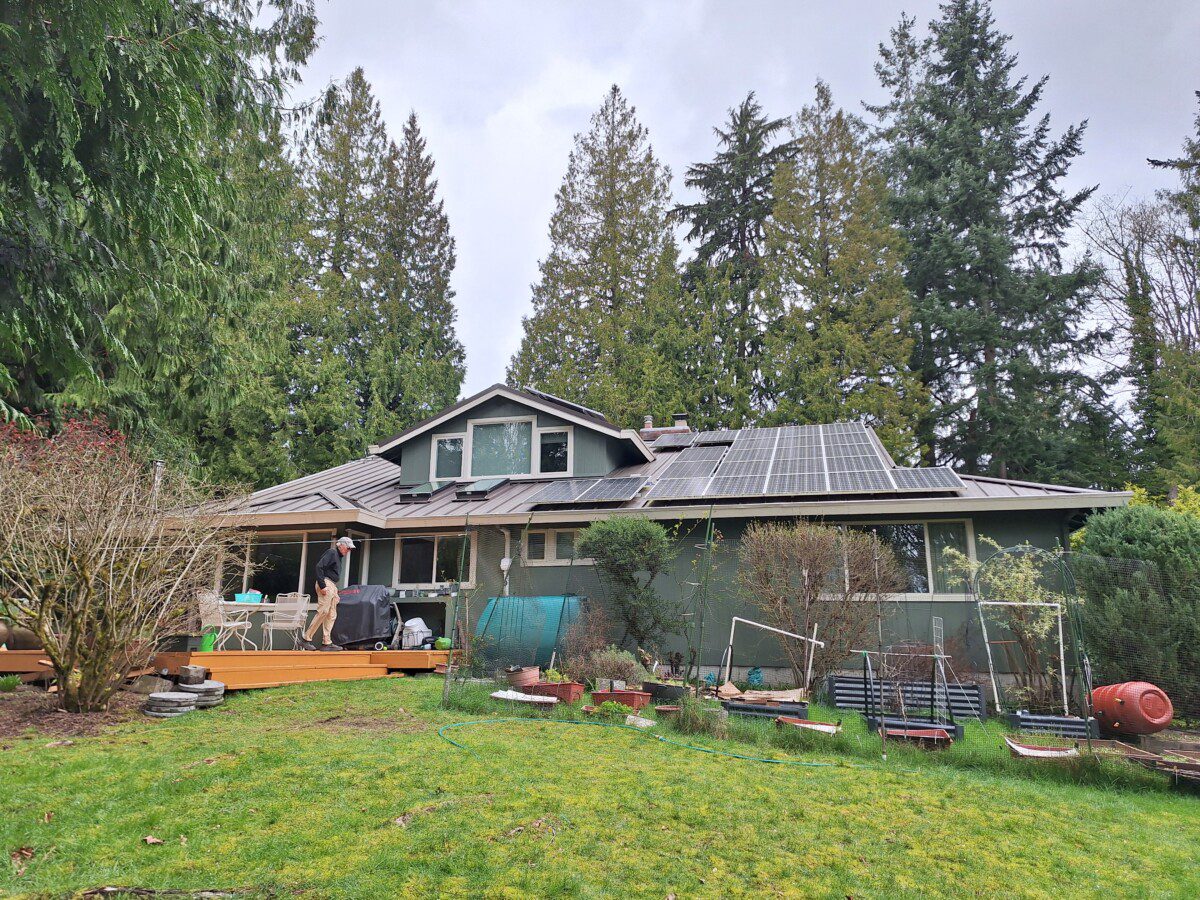
Once the rainy season fills the storage tank, the water becomes available for outdoor use. The homeowner primarily uses the stored rainwater for garden watering and general landscape use during the summer months.
“It’s nice knowing the water is already there when things start drying out,” they explained. “Instead of turning on the hose right away, we can use the rainwater first.”
Another surprise was how quickly the tank filled during steady Northwest rain. “What surprised me was how quickly the tank fills during normal rains,” the homeowner said. “Those storms really do add up.”
To understand how roof size affects rainwater collection, here are several examples using the same calculation method and assuming 16 inches of rainfall between April and October.
| Roof Size (sq ft) | Gallons per Inch of Rain | Seasonal Rainwater (16") |
|---|---|---|
| 500 | 311 gallons | 4,976 gallons |
| 825 | 514 gallons | 8,224 gallons |
| 1,000 | 623 gallons | 9,968 gallons |
| 1,500 | 935 gallons | 14,960 gallons |
| 2,000 | 1,246 gallons | 19,936 gallons |
Actual usable storage will typically be slightly lower depending on system design and overflow behavior.
If you're curious how much rainwater your own roof could collect, you can estimate it using the same method used in this example. The formula is:
Rainfall (inches) × Roof area (sq ft) × 0.623 = gallons of rainwater
Even relatively small roofs can produce thousands of gallons of water each year.
You can estimate the rainwater potential of your own property using our planning tool here: Plan Your Rainwater Strategy
Seven thousand gallons from one roof may not sound like major infrastructure. But multiply that across neighborhoods and the numbers grow quickly.
If 100 homes captured about 7,400 gallons each year, that would equal 740,000 gallons of water captured locally. Instead of flowing directly into the stormwater system, that water could support gardens, landscapes, and outdoor use throughout entire neighborhoods.
For this homeowner, however, the takeaway is simple. “It just feels practical,” they said. “The rain is already falling on the roof. Now we’re actually using some of it.”
A roof can collect thousands of gallons of water depending on its size and local rainfall.
The formula is:
Rainfall (inches) × roof area (sq ft) × 0.623.
For example, an 825 sq ft roof with 16 inches of rainfall produces about 8,224 gallons of rainwater, with roughly 7,400 gallons realistically usable after system losses.
Each inch of rain falling on 1 square foot of roof produces 0.623 gallons of water. For example:
Even small rainstorms can quickly produce hundreds of gallons of roof runoff.
For many homeowners, rainwater harvesting becomes valuable during the dry season when gardens and landscaping need water. Rainwater systems allow homeowners to store water during rainy months and use it later when rainfall becomes less frequent.
Even modest systems can store thousands of gallons of water each year.