
Remote rainwater storage separates where rainwater is collected from where it is stored. Instead of placing a tank directly beneath a downspout, storage can be located where it creates the greatest value for the property.
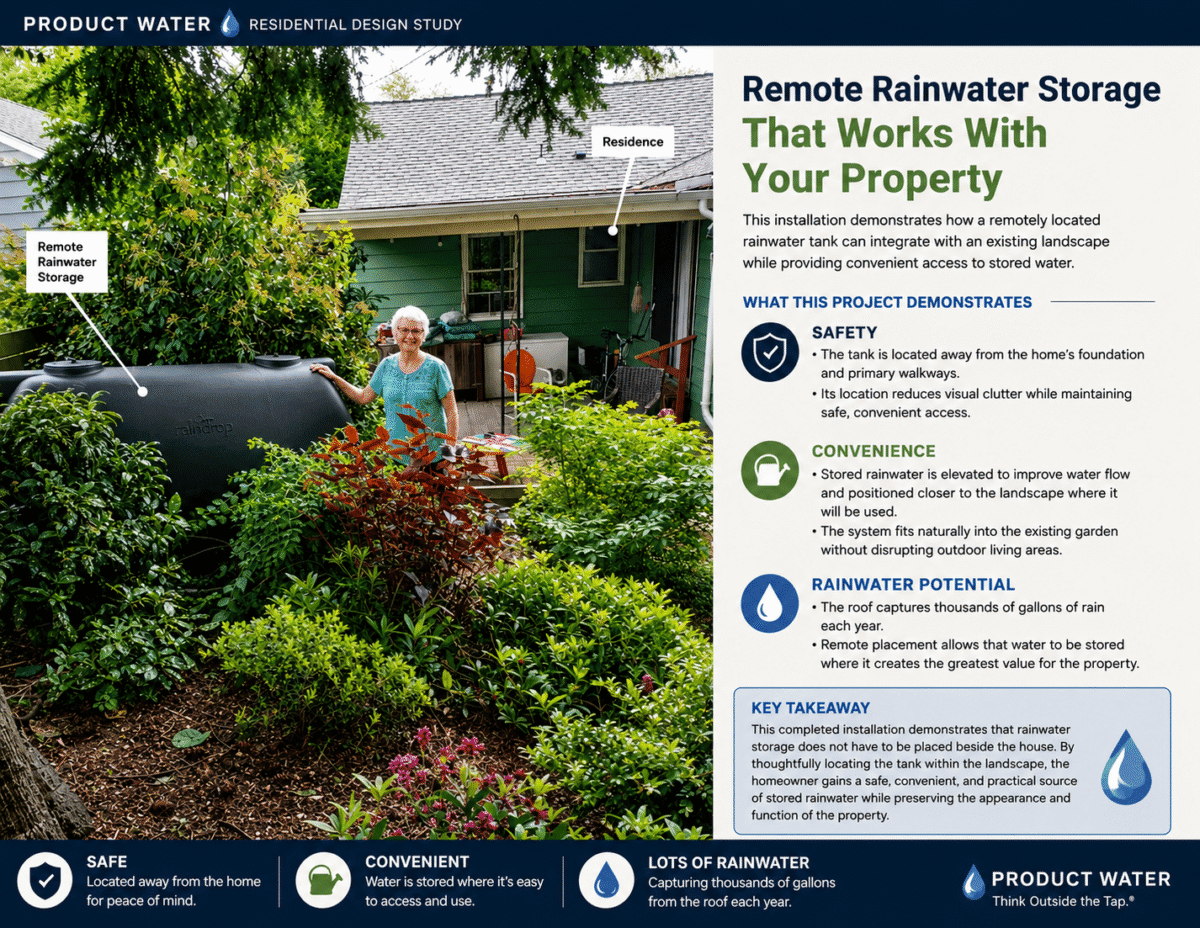
Remote storage improves safety, landscape integration, maintenance access, overflow management, and long-term flexibility.
This approach improves safety, landscape integration, maintenance access, overflow management, and long-term flexibility.
Why place a rainwater tank away from the house? Because the best location for storing rainwater is often not where it leaves the roof.
Remote storage allows homeowners to place water closer to where it will be used while preserving patios, walkways, and outdoor living spaces. It also improves maintenance access and helps manage overflow more effectively.
Most people assume rainwater can only be collected where it falls. It doesn't have to be.
Traditional rainwater systems are typically designed around the location of a downspout, placing storage wherever the roof happens to discharge water. While that location may be convenient for the plumbing, it is often not the best location for the homeowner.
Remote storage changes that assumption.
By separating rainwater collection from rainwater storage, homeowners gain the freedom to locate storage where it creates the greatest value for their property. Instead of allowing the downspout to determine the design, the property itself determines the best location.
That single design decision creates opportunities that traditional systems often cannot. Storage can be placed closer to the landscape where water will be used, integrated into existing gardens, screened by landscaping or structures, kept away from patios, decks, and walkways, and positioned to improve maintenance access while directing overflow safely away from the home's foundation.
This principle represents more than relocating a rainwater tank. It represents a shift in how residential rainwater systems are designed. When collection and storage are no longer tied to the same location, homeowners gain the flexibility to design a system around how they live rather than around where rain leaves the roof.
Remote storage gives homeowners the freedom to decide where rainwater creates the greatest value.
If storage no longer has to remain beneath a downspout, the next question becomes even more important:
Where does all that rainwater come from?
The answer begins with a simple idea:
Your roof is the reservoir.
The roof—not the storage tank—is the true reservoir in a residential rainwater system. Measuring roof area and annual rainfall helps homeowners understand how much water is available before selecting storage.
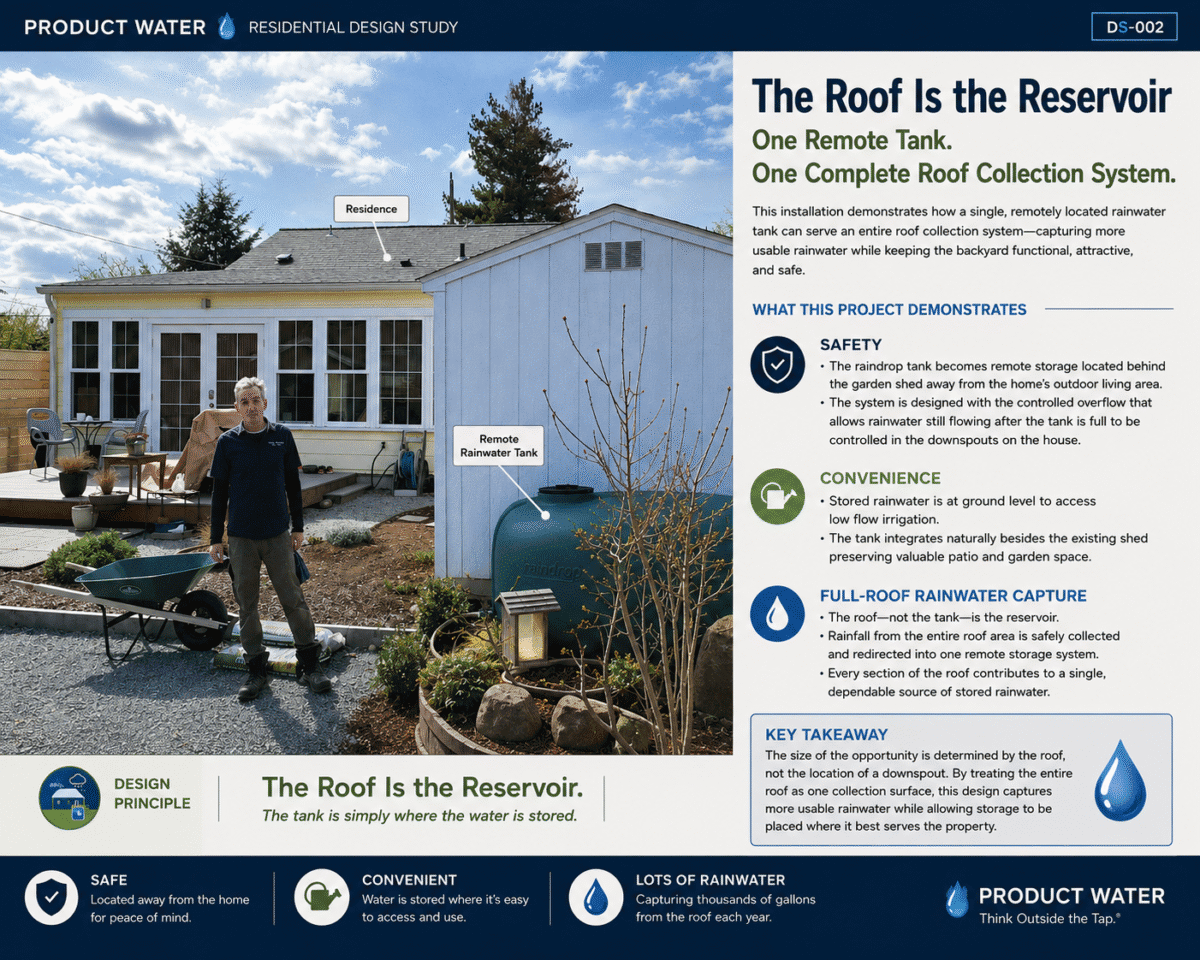
The roof creates the opportunity, and storage captures a useful portion of that rainfall.
The goal is not to capture every gallon of rain but to capture enough to create lasting value through repeated refill during the rainy season.
Why is the roof considered the reservoir? Every rainfall begins on the roof.
A typical residential roof receives thousands of gallons of rainwater each year, creating the opportunity to harvest a valuable resource. The storage tank simply captures and stores a useful portion of that water for later use.
Most homeowners begin by looking at a rainwater tank.
The planning process begins somewhere else.
It begins by looking up.
One of the first steps in planning a residential rainwater system is measuring the roof using satellite imagery. What seems like a simple exercise quickly changes perspective. Homeowners stop looking at their house and begin seeing their roof as a source of water.
The next discovery is often even more surprising.
After entering the roof area into a rainfall calculator, homeowners learn how much rain actually falls on their property each year. A typical 1,500-square-foot roof in the Seattle area receives approximately 33,642 gallons of rainfall annually. The reaction is often the same:
“I had no idea my roof collected that much water.”
That realization changes the conversation.
Instead of asking, “How big of a tank do I need?” homeowners begin asking, “How much of this rainwater do I actually need to capture?”
This shift is fundamental. A rainwater system is not defined by the size of its storage tank. The roof creates the opportunity, while the storage system captures a practical portion of that resource and safely manages the remaining rainfall through controlled overflow.
In Seattle, that opportunity is renewed throughout the year. Approximately 16 inches of rain falls between April and October, with another 20 inches between November and March. Rather than storing every gallon from a single storm, a well-designed system takes advantage of repeated rainfall events. As the tank refills again and again throughout the season, it continues providing usable water while safely managing excess runoff.
The value of a rainwater system is not determined by how much water it can hold on one day. It is determined by how often it refills throughout the rainy season.
The roof creates the opportunity. The storage system captures its value.
If the roof is the reservoir, the next question naturally follows:
How can rainwater reach storage that isn't located beneath the downspout?
The answer begins with the next design principle:
Rainwater can travel horizontally.
Rainwater does not have to stop beneath a downspout. Using gravity, it can be redirected horizontally to remote storage, allowing homeowners to place tanks where they create the greatest value.
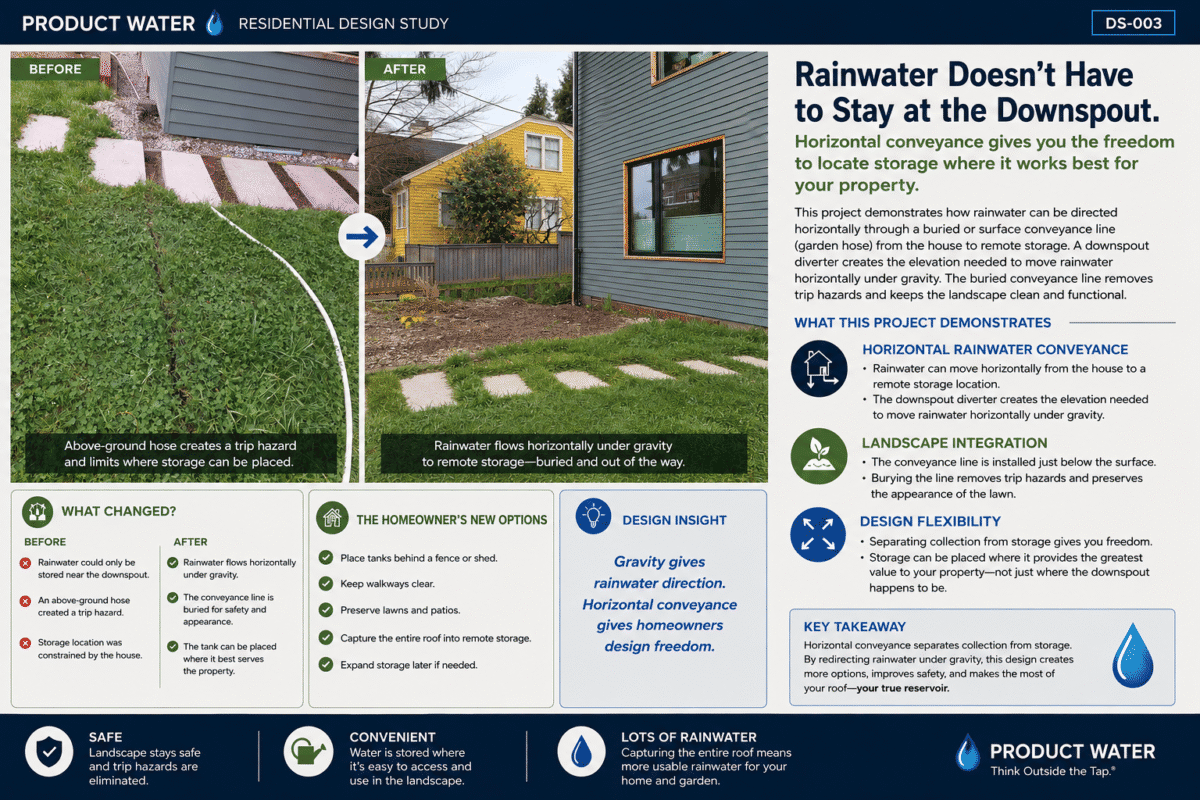
Horizontal conveyance uses gravity to move rainwater from the downspout to remote storage.
This expands design flexibility, supports full-roof rainwater collection, and makes future system expansion easier.
Can rainwater travel horizontally?
Yes. With proper design, gravity can redirect rainwater from a downspout to remote storage. This allows homeowners to choose the best location for storage instead of being limited by where water leaves the roof.
Most homeowners think rainwater can only be captured where it flows vertically from a downspout.
In reality, rainwater can be redirected horizontally to remote storage using gravity.
This principle challenges one of the oldest assumptions in residential rainwater system design. Traditional installations place storage directly beneath the downspout because that is where water naturally leaves the roof. While simple, that approach often limits where storage can be located and how effectively the property can use the collected rainwater.
As larger residential systems were designed, the same challenges appeared repeatedly. Tanks occupied patios, decks, and walkways. Gardens were often too far from the available storage. Many homeowners rejected otherwise effective systems because of their visual impact.
Those recurring challenges led to a different question:
What if rainwater didn't have to stop at the downspout?
The answer was horizontal conveyance.
By redirecting rainwater horizontally, homeowners are no longer constrained by the location of a downspout. Storage can be placed where it creates the greatest value for the property.
The downspout diverter provides the elevation needed for gravity to move rainwater horizontally.
That simple engineering principle unlocks an entirely different way of designing residential rainwater systems.
Horizontal conveyance is more than a method of moving water. It separates rainwater collection from rainwater storage, giving homeowners the freedom to design the property first and the system second.
Every design principle removes a traditional limitation and replaces it with a new possibility. Horizontal conveyance removes the limitation of the downspout and replaces it with the freedom to design the entire property as one integrated rainwater system.
Nature-first design works with natural forces before adding mechanical solutions. By using gravity to move rainwater to remote storage, homeowners can create systems that are simpler, more reliable, easier to maintain, and designed to grow as property needs change.
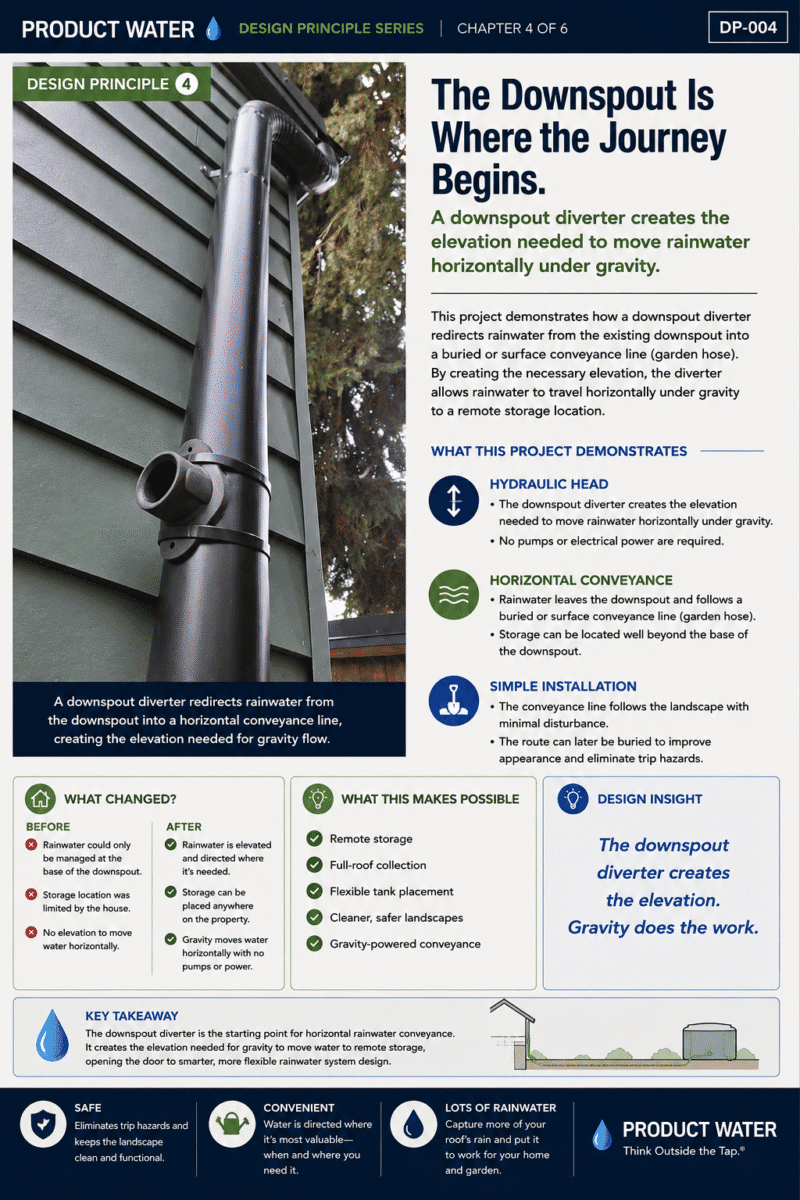
Gravity-first design keeps the system simpler, more reliable, and easier to adapt over time.
Nature-first design works with natural forces before adding mechanical solutions. By using gravity to move rainwater to remote storage, homeowners can create systems that are simpler, more reliable, easier to maintain, and designed to grow as property needs change.
Why use gravity instead of pumps?
Gravity provides a dependable, low-maintenance way to move rainwater to storage. By relying on natural elevation before mechanical equipment, homeowners gain greater design flexibility while reducing complexity and improving long-term reliability.
Most homeowners think adding more capability requires more complexity.
In reality, thoughtful design often reduces complexity by working with nature first.
For generations, residential rainwater systems have relied on the assumption that moving water requires additional equipment. While pumps certainly have their place, they are not always the best starting point. Good design begins by using the natural advantages already available.
Gravity is one of those advantages.
By using gravity first, homeowners gain the freedom to place rainwater storage where it creates the greatest value for their property rather than where mechanical equipment makes it possible. The result is a system that is simpler to maintain, easier to expand, naturally reliable, and capable of adapting as the property's needs change.
One of the key components that makes this possible is the downspout diverter. It creates the elevation needed to move rainwater horizontally under gravity. Instead of relying on pumps to move water, the system redirects rainwater safely to remote storage while maintaining controlled overflow.
This approach creates opportunities that extend well beyond the initial installation. A homeowner may begin with one storage tank today, then add storage capacity, expand irrigation, or adapt the system as the landscape evolves. Because the design begins with natural forces, the system can grow with the property rather than being limited by its original installation.
A successful rainwater system should not be judged by how much equipment it contains. It should be judged by how naturally and reliably it performs. Well-designed systems continue operating even without electrical power, quietly directing rainwater where it is needed while safely managing excess runoff.
Nature has already solved part of the problem. Good design begins by working with it rather than around it.
The simplest systems are often the most dependable because they allow nature to do the work first.
If natural forces can move and store rainwater effectively, one important question remains:
How should a successful rainwater system be measured?
Is success determined by the size of the tank—or by the value the system continues creating every time it rains?
That question leads to the final design principle of Part One.
A successful rainwater system is measured by repeated refill rather than storage capacity alone. The roof receives far more rainwater than most landscapes require, allowing well-designed systems to capture, store, and replenish water throughout the rainy season.
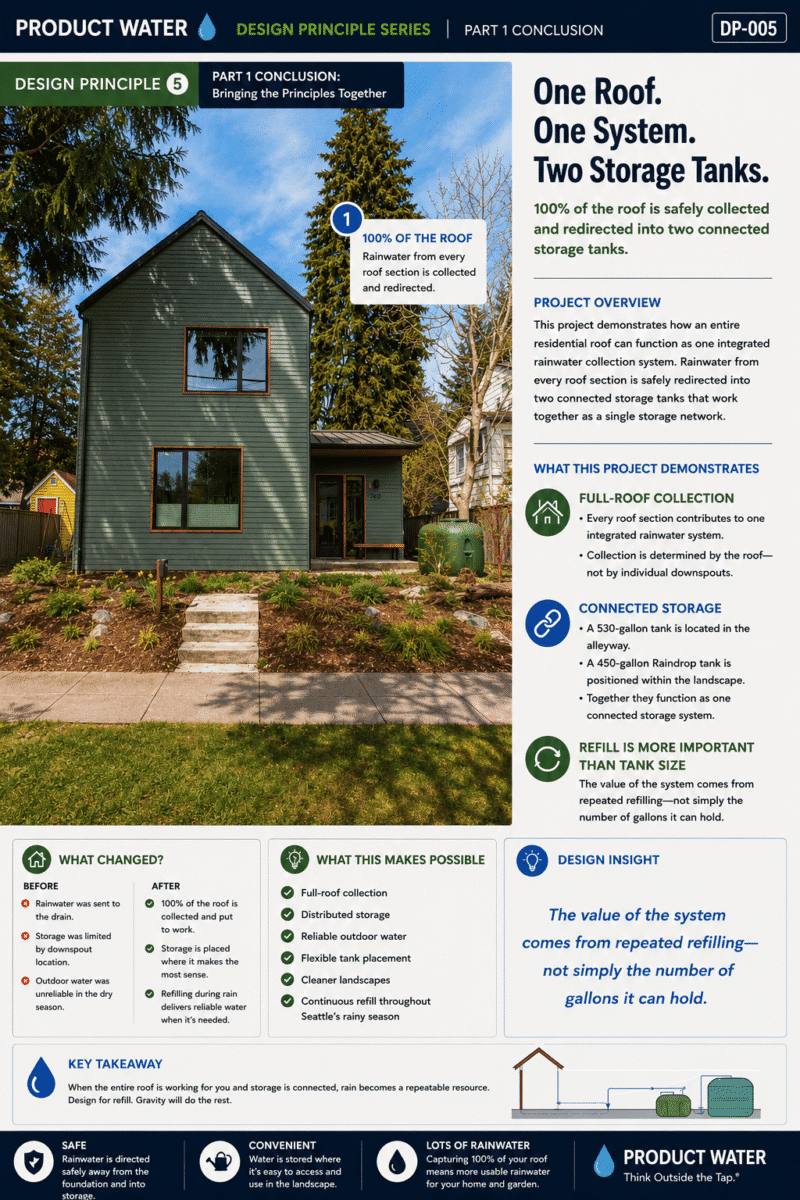
Long-term value comes from repeated performance, not simply from larger tanks.
Long-term value comes from repeated performance—not simply from larger tanks.
Is a bigger tank always better?
No. A well-designed rainwater system is measured by how often it refills and continues providing usable water over time—not simply by how many gallons it stores on a single day.
Most homeowners measure a rainwater system by one number:
How many gallons does the tank hold?
It seems like the logical way to judge a system.
In reality, storage capacity is only part of the story.
A successful residential rainwater system is not defined by the number of gallons it can store on a single day. It is defined by how often it captures, stores, and refills throughout the rainy season.
This is the most important shift in understanding residential rainwater systems.
The roof receives thousands of gallons of rainfall every year. A well-designed system does not attempt to store every gallon. Instead, it captures a useful portion of that rainfall, stores it where it creates the greatest value, safely manages overflow, and prepares for the next storm.
Every rainfall becomes another opportunity.
In Seattle, approximately 16 inches of rain falls between April and October, followed by another 20 inches between November and March. Those frequent storms allow properly designed storage systems to refill again and again. Instead of relying on one large reserve of water, homeowners benefit from repeated opportunities to replenish their stored supply.
That changes how success should be measured.
The value of a rainwater system comes from repeated refilling—not simply the number of gallons it can hold.
Designing for refill also creates flexibility for the future. Homeowners can begin with storage that meets today's needs and expand over time as landscapes mature, irrigation demands change, or additional opportunities arise. The system grows with the property rather than being oversized from the beginning.
Together, the first five design principles form a complete design philosophy:
Together, these principles transform rainwater from something that is simply managed into a dependable resource that continues creating value every time it rains.
The value of a rainwater system comes from repeated refilling—not simply the number of gallons it can hold.