

How Much Rainwater Can a Seattle Roof Produce? A Real RainWise Home Example
Many homeowners underestimate how much water falls on their roof each year. In Seattle, consistent rainfall means even a modest roof has significant rainwater harvesting potential. Understanding Seattle rainfall, roof rainfall, and how water moves across a property is the first step toward designing a practical rainwater system that can support gardens and landscapes through the dry season.
A typical 1,750-square-foot Seattle roof receives about 19,600 gallons of rain per year. Most residential rainwater systems store only a small portion of that rainfall. The real question is not how large the tank should be, but how often that storage can refill throughout the year.

This South Seattle home offers a practical example of how a rainwater system can be designed around the realities of Seattle rainfall and site conditions. Located in a RainWise-eligible basin, the house originally directed all roof runoff into an underground pipe that carried water away from the property. Like many homes in the area, the drainage system worked exactly as intended—but the water itself remained invisible and unused.
The roof area measures approximately 1,750 square feet. Seattle receives about 37 inches of rainfall each year. Using a simple rainfall calculation, that roof receives roughly 19,624 gallons of rainwater annually. Before the rainwater system was installed, every gallon flowed directly into the drainage system and left the site.
Rainwater potential can be estimated with a simple formula: annual rainfall (inches) multiplied by roof area (square feet) multiplied by 0.623 equals gallons of water. Rather than calculating it manually, homeowners can estimate their own roof’s rainwater potential using the Product Water rainwater harvesting calculator at
.
To put the numbers in perspective, a 1,000-square-foot Seattle roof receives roughly 11,200 gallons of rain per year. A 1,750-square-foot roof receives about 19,600 gallons. A larger 2,500-square-foot roof receives approximately 28,000 gallons annually. These numbers often surprise homeowners because Seattle rain tends to arrive as frequent, lighter storms rather than dramatic downpours.
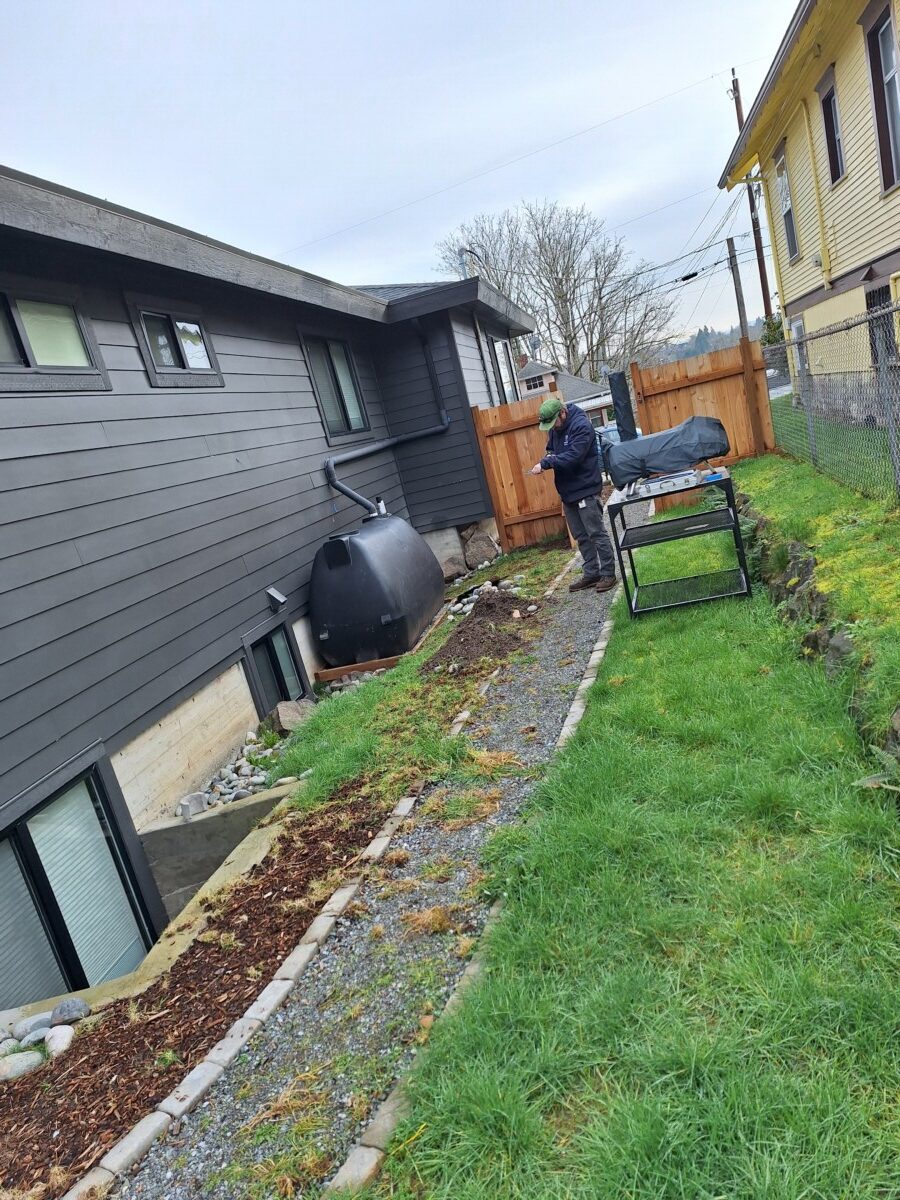
At Product Water, rainwater systems are designed around refill behavior rather than tank size. Many people begin by asking how large their storage tank should be. In reality, the more important factor is how frequently that storage can refill. A rainwater system is not a bathtub that holds a fixed amount of water. It behaves more like a refillable reservoir. When roof runoff replenishes storage repeatedly throughout the year, modest storage volumes can reliably support outdoor water use.
This principle is especially relevant in Seattle, where rainfall patterns support frequent refill cycles. Instead of trying to capture every drop of rain that falls on a roof, a well-designed system stores a strategic portion while safely managing the rest.
Rainwater systems in Seattle also perform two different jobs during the year. During the wet season, roughly November through March, the system’s primary role is stormwater management. Water must move safely and predictably through the site during sustained rainfall events. During the shoulder and summer months, roughly April through October, the system’s role shifts toward refill and recharge. Even brief summer rainstorms can replenish storage when the system is positioned correctly.

This particular project became possible through the RainWise program. RainWise is a Seattle Public Utilities program that helps homeowners install cisterns and rain gardens to reduce stormwater entering the city’s combined sewer system. The program offers financial incentives for installations that meet specific design and installation requirements. More information about the program can be found on the Product Water RainWise page at
.
For this South Seattle home, the rainwater system follows a straightforward design approach. Roof runoff is intentionally redirected into storage before leaving the site. Approximately half of the roof area drains toward the north side of the home, while the remaining half drains toward the south side. This routing allows storage to be placed where gravity can work effectively.
Storage is provided by two 450-gallon tanks, one positioned on each side of the home for a total of 900 gallons of capacity. The tanks are located slightly downhill from the gutter lines, allowing gravity to move water naturally from the roof into storage. Their placement also keeps them visually integrated with the landscape rather than dominating the yard.
Water stored in the tanks is intended primarily for low-pressure irrigation. Gravity provides the pressure needed for drip irrigation systems when the storage tanks sit higher than the garden beds. This gentle pressure often works well for plants while keeping the system simple and reliable. Pumps can be added in special situations, but they are not required for normal operation when elevation is used correctly.
Overflow from the tanks returns safely to the same underground pipe that previously carried roof runoff away from the property. During heavy rainfall events, water continues through the established drainage path without interruption. During lighter rainfall, the tanks refill and store water for later use. In a properly designed rainwater harvesting system, overflow is expected behavior rather than a sign of failure.

The system is intentionally framed as design-first rather than results-first. In its first year of operation, several things are already clear. The tanks are positioned to refill efficiently during summer rain events. Gravity provides the pressure needed for irrigation without mechanical pumps. Storage is sized as a buffer rather than an attempt to capture the entire roof’s rainfall. Landscaping decisions can now be made with a reliable supplemental water source already in place.
Rainwater harvesting works best when it is considered early in the design of a property. If irrigation systems and landscaping are installed first, retrofitting storage later can become more complicated and expensive. By planning water infrastructure before planting begins, homeowners can align garden design with the water that naturally arrives on the site.
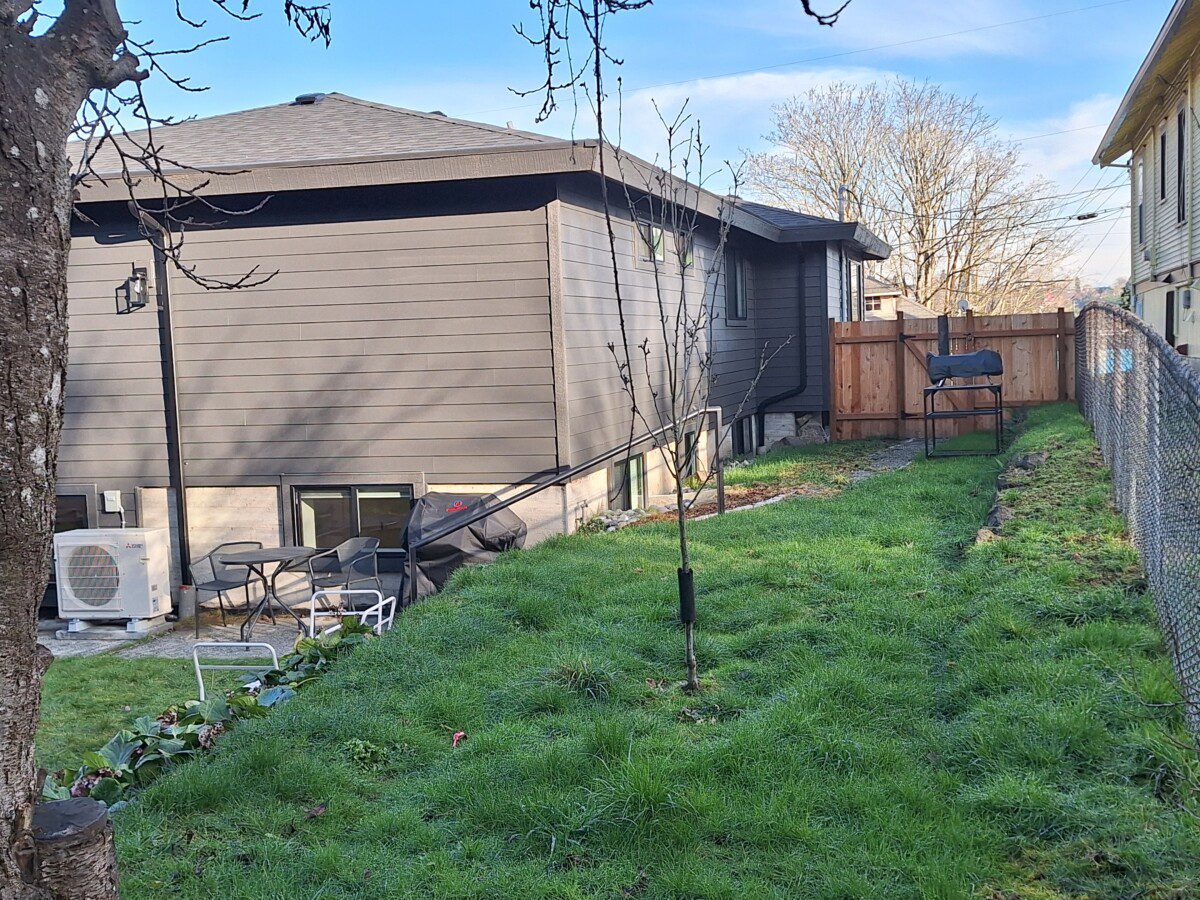
Product Water approaches rainwater systems as small pieces of practical infrastructure. Each home demonstrates how water can be managed thoughtfully at the property scale. Instead of treating rain as something to dispose of as quickly as possible, the system captures a useful portion while allowing the rest to continue through the drainage network safely.
Homeowners who are planning landscaping, irrigation upgrades, or gutter work in Seattle or King County may benefit from evaluating rainwater opportunities early in the process. Even modest roofs produce thousands of gallons of water each year. When storage is placed in the path of water that is already moving through the site, rainwater can become a practical and reliable supplemental water source.
Rainwater does not need to be complicated to be useful. It simply needs to be designed around gravity, elevation, and the way water naturally moves across the property.
Think outside the tap.
Rainwater Harvesting FAQ
How much rainwater can my Seattle roof collect?
As a rough estimate, multiply your roof area (square feet) by annual rainfall (inches) and then by 0.623 to get gallons per year. For example, a 1,750-square-foot roof in Seattle can receive nearly 20,000 gallons of rain annually.
Do I need a very large tank to make rainwater useful?
Not necessarily. In Seattle, the key is how often your storage can refill, not just how big the tank is. A modest tank that refills frequently can reliably support outdoor irrigation when it is placed in the natural path of roof runoff.
“`